*** 2025 East Barriere Lake Wildfire Risk Reduction – Request for Proposals ***
Operational Fuel Management Treatments – East Barriere Lake (EBL2025TU1-2)
Overview: The Lower North Thompson Community Forest Society (LNTCFS) is seeking proposals from qualified contractors for operational fuel reduction treatments in the East Barriere Lake area. Work includes thinning, pruning, danger tree falling, piling, and burning across two treatment units totaling 22.5 hectares.
Contract Term: Work is expected to be completed by March 31, 2026, with the option of a one-year extension subject to performance and funding.
Submission Deadline: May 23, 2025, at 2:00 PM Pacific Time
Submit proposals by email to: LNTCFSociety@telus.net
Subject line must include: “Proposal – EBL2025TU1-2”
Contact for Inquiries: Mike Francis, General Manager (LNTCFSociety@telus.net)
Attachments (3 total)
Full RFP
Contract Template (Appendix A)
Proposal Response Form (Appendix B)
LNTCFS Wildfire Risk Reduction Background Information
In 2019, the Lower North Thompson Community Forest initiated the development of its Wildfire Risk Management Plan (WRMP) with the assistance of Forsite Consultants Ltd. This project was identified as a vital investment in forest planning and management, particularly in light of several challenging wildfire seasons that have affected our ecological, economic, and social values.
LNTCFS Wildfire Risk Management Plan Document
Wildfire risk was analyzed using a modified burn probability approach, which assessed both ignition probability (from lightning and human activities) and headfire intensity. This analysis utilized data from provincial weather stations, the fire weather index, elevation, and fire behavior prediction fuel types. As a result, we identified specific areas within the Community Forest tenure that correspond with human presence, including residential, industrial, and recreational developments.
The forest structures within the Community Forest are complex and multi-storied, exhibiting a high degree of horizontal and vertical fuel continuity. This composition increases the likelihood that ground fires can escalate into higher-intensity crown fires.
LNTCFS Cumulative Wildfire Risk Map
In response to the creation of the Wildfire Risk Management Plan (WRMP), several management strategies were developed to enhance forest resiliency. These strategies include:
Collaborative Planning: Enhancing landscape resiliency through cooperation with regional land managers, adjacent tenure holders, and supporting authorities.
Wildfire Management Zones: Designated priority areas where wildfire risk reduction activities can have the greatest positive impact.
Silviculture: Targeted interventions and approaches that enhance forest resiliency while ensuring compliance with legal tenure obligations.
Strategic Harvest Areas: Specific methods and management activities aimed at mitigating wildfire risk. This includes overstory and surface fuel removal, understory treatments, and effective slash management. A primary objective of forest harvesting is to reduce wildfire risk.
Use of Prescribed Fire: Implementing post-harvest burning to minimize surface fuel hazards, in partnership with BC Wildfire Service and local First Nations.
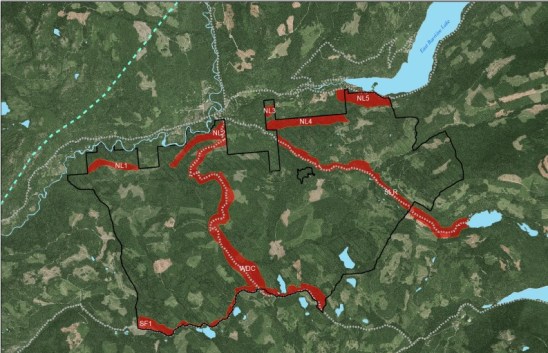
In 2021, LNTCFS staff, in collaboration with Forsite Consultants, began collecting fuel inventory data to create Fuel Management Prescriptions for several proposed treatment units along the Lower Wikkiup – South Barriere Lake Forest Service Road (FSR) and the East Barriere Lake FSR portions of our tenure (refer to NL1 to NL5 strategic harvest areas above).
The Wildfire Risk Reduction fuel treatments encompass three broad approaches: Clearcut with Reserves, Select Harvest, and Hand Treatments. The layout of treatment areas was completed later in the fall and winter of 2021. To date the LNTCFS has developed fuel management prescriptions for ~200ha of area within its K1Z tenure area; approximately 140ha have been treated for wildfire risk reduction.
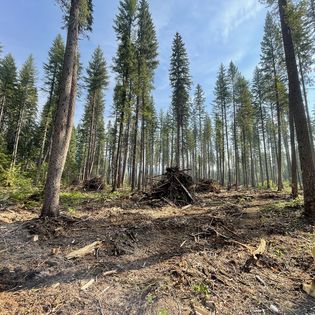
In 2021, we also harvested our first five Wildfire Risk Reduction (WWR) blocks, K1Z 010-1 to K1Z 010-5, located in the Lower Wikkiup area. These blocks were harvested using a clearcut with reserves approach, chosen to suit the specific forest and site conditions. By the summer of 2023, these areas were stumped, piled, and reforested. These harvest areas overlap with portions of the Barriere Lakes Wildland Urban Interface (WUI), providing protection for adjacent private properties.
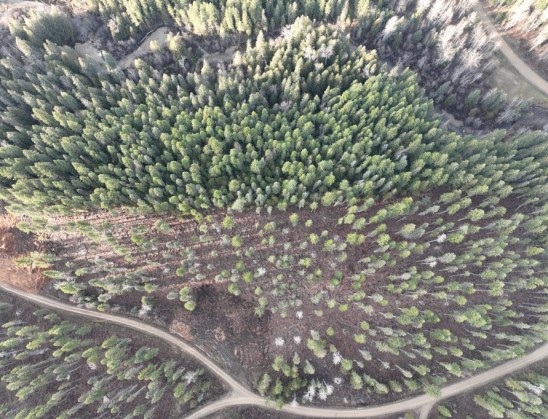
In 2022, we harvested five additional Wildfire Risk Reduction (WRR) blocks, K1Z 010-7 to K1Z 010-11. The first three areas, located along the Lower Wikkiup and South Barriere Lake FSR, were harvested using a selective method aimed at removing dead, diseased, dying, and suppressed trees while retaining at least 50% of the pre-harvest basal area. This approach resulted in a significantly more open forest primarily dominated by Douglas-fir and Interior Spruce, with lesser amounts of Western Hemlock, Western Redcedar, and Western White Pine. These areas do not require reforestation due to the high levels of retained trees.
The last two blocks, located on East Barriere Lake FSR, were harvested using a clearcut with reserves approach, chosen based on forest and site conditions. The pre-harvest stand in these blocks had high levels of dead pine, and the rocky, steep slopes supported a Pine-Fir-Birch forest that was heavily impacted by the 2008 Mountain Pine Beetle and ongoing issues with Armillaria Root Disease. This led to the accumulation of large-diameter surface fuels (over 20 cm) and increased wildfire risk. These blocks have been stumped and piled where slopes permitted and were reforested in the spring of 2024.
For now, we will maintain access to Lakeview Road for silviculture and development activities. We plan to implement hand treatments in the NL5 area adjacent to East Barriere Lake FSR and the two blocks to further enhance wildfire resiliency in this part of the East Lake Community. We kindly ask the public to respect these areas and the recreational opportunities they provide for both locals and visitors.
#PackOutWhatYouPackIn
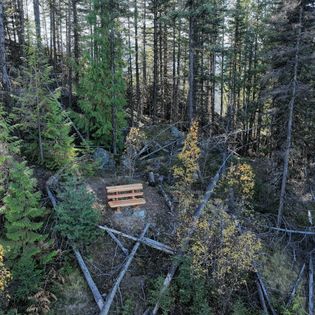
For easier access, people can drive to the upper parking lot on Lakeview Rd and access either of the benches via the East Lake Grind Trail
 Lower North Thompson Community Forest Society